“When I’m working with young artists, particularly through the Adelaide Cabaret Festival’s ‘Class of Cabaret’ programme, one of the things that we say to the students right from the outset is that one of the points of good art, and in this instance cabaret, is that you have the opportunity to ask people to see the world through an experience that’s different to their own.
“Different people take different approaches, but essentially what you’re doing is you’re asking people to view the world through a lens that they may never get the chance to view it through.”
“That’s what good art does. That’s what this piece does. It enables you to see directly the impact that other people’s decisions and actions can have on a life, either inadvertently or advertently, either for good or for evil, in a way that you might never see.”
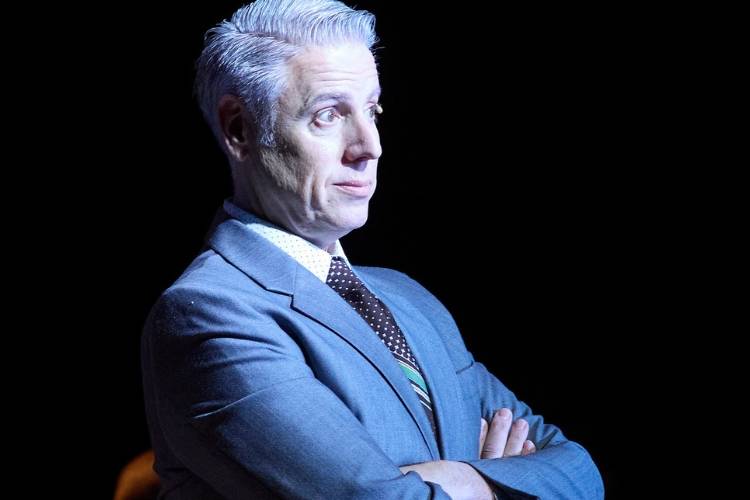
Mark Oates reprises 'Watershed' with Opera Australia for a Melbourne season this November, returning to his dual role as Dr George Ian Duncan and Don Dunstan. Written as part oratorio, part opera, it combines soloists with a chorus, interpretive dance and dramatic staging to tell the story of 'The Death Of Dr Duncan' and the social and political movement in its wake.
The original brief came out while Mark was touring with Co-Opera in Roxby Downs. Mark spent his spare time helping a colleague he thought would be perfect for the production prepare his audition and nearly didn’t submit one of his own.
“I know you’re travelling today. . . You have till lunchtime tomorrow. We really, really want you to put in a submission.”
Submit.
Neil Armfield, then co-Artistic Director of Adelaide Festival and director of 'Watershed', invited him into the final development workshop rather than handing him the role he’d soon step into. Composer Joseph Twist and librettists Alana Valentine and Christos Tsiolkas were writing new material throughout the formative rehearsal week.
“They wrote new music for me every day. Joe was considering my voice and the way I was presenting the material in the new music.”
One of those pieces became 'Drowning Song for Ian'. On opening night, Armfield gave Mark a card.
“The first time I heard you sing 'Drowning Song for Ian', I knew you were the right person to tell this story.”
Mark says he’ll never forget it.
The story Mark was chosen to tell in this oratorio flows back to 1972 on the banks of Adelaide’s Torrens River. Dr George Ian Ogilvie Duncan migrated to South Australia to take a position lecturing law at the University of Adelaide. Months after his arrival, on 10 May, he was thrown into the murky water near the university footbridge and drowned. The riverbank was an unspoken place where gay men would meet in secrecy at a time when homosexual acts between men were illegal and there was a culture of violence and intimidation towards gay men. Vice Squad, a branch of South Australia Police, were tasked with patrolling the riverbank beat. Suspicion centred around three men in the force, caught in the vicinity that night, who refused to answer questions at the coronial inquest and later resigned from the force. Nobody has ever been convicted of his death.
Duncan’s murder caused public outrage, adding momentum to the growing homosexual law reform movement, and in 1975, under premier Don Dunstan, South Australia became the first Australian jurisdiction to fully decriminalise homosexuality.
“I knew a lot about Don Dunstan and his time as premier. But as a young man, rather naive man, I had not recognised the significance of this moment. It was incredibly opening and devastating to discover this history all at the same time, but also to feel such a deep connection to the sense of social justice that really drives me and the kind of art that I’m interested in now.”
In The Sensible Centre sat a group of women who weren’t necessarily connected to the gay community and may not have approved of homosexuality, but who stood up and said, “this is not right”.
The work describes them as the “Burnside mums”, whose response Mark says became one of the most significant drivers for change.
The Lost Boy (a character representing the young gay men who went missing during that period) says, “Another homo is dead. Is anyone gonna grieve him? His own mother was dead, his half sister was dead, but the mothers of Adelaide mourned, the daughters of Adelaide mourned, the well-heeled ladies and matriarchs, the gentlewomen and society ma’ams.”
At The Sensible Centre, disapproval becomes defiance:
“I don’t particularly like them. It’s not a lifestyle I endorse. I try not to think about what they do in bed. I find men in general coarse.
“I’m certainly not one of them, and I wouldn’t want my own child to be. I don’t know why they favour sodomy. I suppose that they have their needs.
“Surely we draw the line at murder for sport, at police brutality, and surely we draw the line at indecent assault on a visitor to this country.”
“This work is about recognising that other people’s lived experiences are different to yours. It’s about recognising that other people’s values don’t demean or diminish your values and if you use your values to demean or diminish other people, ugly and horrible things can happen. When you don’t live in respect of other people, when you are so trapped by your own perspectives that you don’t recognise that other people’s lived experiences are different. . . Then you are destroying a life.”
More than 50 years have passed since Duncan’s murder, yet the lessons learned along the way, and those which may have fallen on deaf ears, carry the same relevance today.
“We felt over the last 40 to 50 years in particular that we had made great steps in the way people thought about social justice, but the last 10 years have actually really frighteningly shown us that there is still a very large part of the community that didn’t change the way they thought. They only changed the way they knew they were able to speak in public.”
The Lost Boy sings of someone who vanished in the violence of South Australia’s dark history.
One night, he wasn’t there. Did he go over east? Or across to Loxton, or Port Augusta. . .
They bashed him, they broke him, they made him disappear.
“The way the lovers are separated on stage is one of the most deeply moving pieces of theatre I have ever seen – I cry just thinking about it, even now.”
Mark walks off the stage carrying with him a deep pain and a longing for a world without fear. What he sees from backstage is only a shadow of what is happening. He has brought a story from the shadows into the spotlight, carrying with it questions haunting the present.
“From off stage Pelham and I can’t actually see it happen. We see a shadow of it from the light, reflecting on the side stage wall, which is somehow even more devastating. And this is why this piece is still so important now, even as a reflection of something that happened 50 years ago, and will continue to be important while we continue to have a world where people are so frightened of people that are different to them, that they can’t respect them and they want to shove them into their own box.”
“That line, ‘they bashed him, they broke him, they made him disappear’. . . In both a literal and a figurative sense, is such a powerful message about what we can do to other people when we can’t live in respect for them, and their honesty and their truth.”
'Watershed' plays Arts Centre Melbourne 21-28 November.
This story originally appeared on our sister site, scenestr.