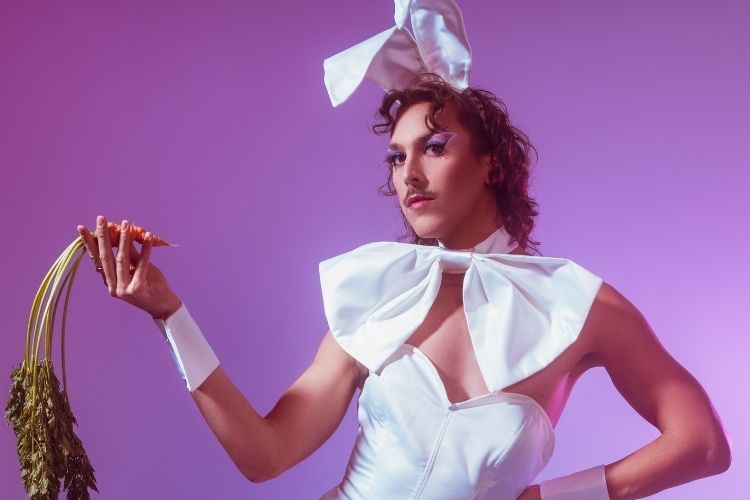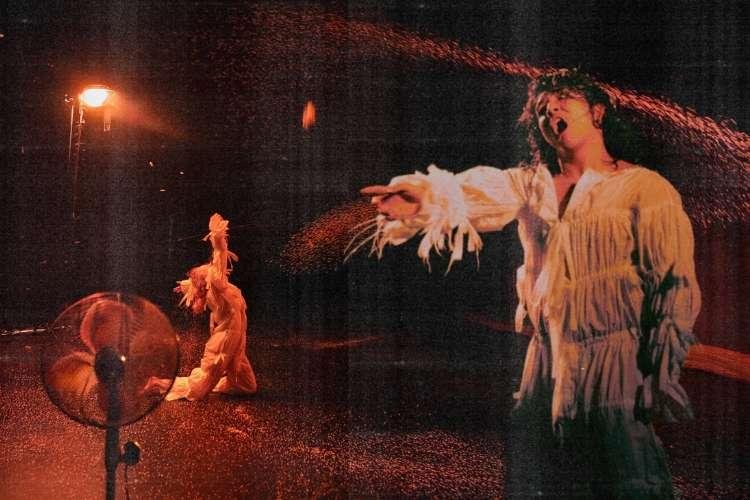
Created by rising Queensland talent Buddy Malbasias and featuring co-star Clare Dark, the work dives headfirst into the Filipino philosophy bahala na (“whatever happens, happens”) to explore life between cultures with heart, humour and chaos.
Part dance piece, part fever dream, part rice-fuelled ritual, 'Bahala/o' throws genre out the window. Expect a rice rave, a Budots runway, a not-quite-musical and moments of raw personal storytelling, woven through bold movement and striking imagery.
In 'Bahala/o', ritual lives in the rhythm of breath, in the act of throwing rice, in the moments of surrender and absurdity. It’s not about following a prescribed order, but about finding meaning through doing — through sweat, impulse and instinct.
Ultimately, ritual in this work is a return — a remembering of who we are, who we’ve been, and who we’re still becoming.
Ahead of the 'Bahala/o' season at Brisbane's Metro Arts, we caught up with Buddy to talk identity, ritual, performance, creating, and more.
For those who haven’t heard about 'Bahala/o' yet – how would you describe the show in your own words?
'Bahala/o' is my love letter to contradictions – seriously unserious, tender yet cheeky, deeply Filipino and delightfully queer. It’s about surrendering to the experience, holding the weight of identity and celebrating ourselves in all of our multiplicities. It’s for anyone living in diaspora or anyone who’s ever felt like they don’t quite fully belong. For those who love dance but also love theatre, and don’t want to choose between the two. For lovers of all movement forms, not just contemporary! And honestly, it’s also for anyone who just wants to experience some juicy, fun art – playful, cheeky and full of heart. Come laugh, reflect and revel in some dance theatre, and yes, you actually get to throw rice at us!
The title draws from the Filipino saying 'Bahala Na' – what does that phrase mean to you personally, and how does it shape the energy of the performance?
‘Bahala na’ is often translated as ‘whatever happens, happens,’ ‘YOLO,’ ‘F... it.’ But for me, it brings a multiverse of meanings. It’s paradoxical; carrying surrender, trust in fate but also responsibility and agency. The root word ‘bahala’ itself means to take care, to hold responsibility, to carry weight, whether that’s history, identity or contradiction. It’s both a burden and a gift. For context, the title design reflects this complexity. The slash ‘/’ represents multiplicity of self. ‘Bahala’ also has interesting variations on how it’s used, reflecting on the ‘multiverse of self’. The shifting ‘a’ and ‘o’ play with Filipino linguistics around gender, and in Baybayin script, ‘ba’ links to babae (female) and ‘la’ to lalaki (male), inviting a reflection on gender and liminality. At its core, 'Bahala/o' lives in liminality. That space between control and surrender, tradition and transformation. All these design elements show up in the work. Through this work, I explore ‘Bahala na’ in the context of the Filipino-Australian queer experience; where identity is always shifting, adapting, negotiating. It’s not about offering answers, but about inviting reflection: how do we express ourselves fully, in all our multiplicity? How do we honour where we come from while making space for who we’re becoming? For me, 'Bahala na' reflects the in-between; the imperfect, the uncertain and the complex beautiful negotiation of identity. It’s a phrase that, in this context, becomes an act of reconnection. For me, it’s not just about reconnecting to cultural heritage, but to all the neglected parts of the self; the identities we’ve outgrown, suppressed or left behind. In 'Bahala/o', you’ll see fragments of my what ifs, my regrets and the versions of myself I’ve had to release or continue to hold close. To say "Bahala na" isn’t an act of absolute surrender — it’s a kind of rootedness, a quiet trust that even in letting go, there’s something deeper holding you. It’s a faith that lets you leap, to YOLO, knowing you’re anchored to something larger than yourself. At the same time, to say 'Bahala na” is, in its own way, a small death; a gentle surrender of all the potential selves we might have been. While the phrase can sound playful or carefree, beneath it lingers something far more complex: a quiet, introspective darkness that exists between faith and uncertainty. That tension, between letting go and holding on, is what fuels the work.
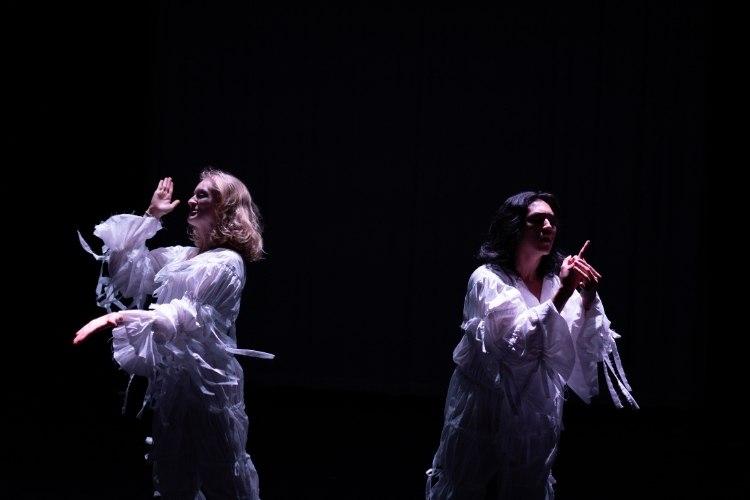
Image © Georgia Haupt
There’s mention of rice, ritual and even a rice rave! How did these elements come together in the creative process?
Honestly, it all came together by chance or maybe, more truthfully, by pure ‘Bahala na’ energy. The creative process for 'Bahala/o' has always lived in uncertainty. There was never a strict A-to-Z plan, no blueprint for how it would arrive at Metro Arts. Everything unfolded quite spontaneously, which in itself feels very ‘Bahala na’ — surrendering to what comes, trusting that the pieces will find their place. It actually began as an invitation from Liesel Zink to share some early ideas, a solo with rice bags in a traverse setting. I’ve always loved working with found objects and shaping audience experience. I think in design before I think in choreography. Often, images appear in my head from lived experience. . . Or sometimes, let’s be real, from Pinterest (haha). When the duet began to take form, the pedestal fan appeared, and suddenly the opening sequence felt almost ritual-like — an invitation for the audience to step into the world. Rice was really the starting point for this work and the world it lives in. I wanted to begin with my staple and for so many Asian cultures, that’s rice. Rice, of course, holds deep symbolism across many Asian cultures, including the Philippines. It’s sustenance, offering, celebration, and grief – it’s life itself. I didn’t know exactly how it would unfold; I just had this image in my head and wanted to play. As we explored, these motifs naturally wove themselves into the work. It became a playground where tradition and the self could beautifully co-exist. In 'Bahala/o', ritual isn’t confined to religion or ceremony; it’s an embodied act of remembrance, repetition and release. It’s the small gestures that link the personal to the ancestral, the mundane to tradition. For me, ritual is about reconnection – to memory, to identity, to all the forgotten fragments of self. It’s both performance and offering: a space where movement becomes almost like a prayer, where rice becomes both sustenance and symbol, and where clarity and chaos hold hands. Each development deepened that balance; the work grew louder, softer and somehow more itself. More chaotic self energy. More “why not?” I always joke that maybe in another life, or another multiverse, I’d do it differently, but this time, I thought, no, we’re doing it in this universe.
The show plays with living between cultures and identities – was there a particular moment or experience that inspired you to explore that theme through performance?
'Bahala/o' is the first chapter of my broader creative universe, the Bugas (translating to 'Milled Rice' in Bisasya, my mother tongue) multiverse. It’s a growing collective body of work that explores identity and reconnection through different lenses. It’s not linear or prescriptive, but abstract, contemporary and deeply honest. The seed for it was planted during a huge turning point in my life. After graduating, I felt like I was at my ‘peak’ as a young budding overthinking perfectionist; fresh from a scholarship in Europe, doing exciting work, hungry to prove myself. I told myself I needed to create my first full-length show, to outdo everything I’d done before. But the truth was, I didn’t know what I was doing, I had no money, no backing – just a dream and 30 days. I even announced the work publicly before I knew if I could actually make it happen. (And let’s just say. . . Creating a full-length show really does need all the time, energy and support!) The next day, my family received tragic news, my grandfather had passed from mental health struggles. “He took his life”, I came home to from dance practise. We rushed back to the Philippines and everything changed. That time forced me to pause, to ask myself what really matters. It was a three-week open casket filled with vigils, ceremonies and deep mourning – rituals that were both painful and grounding. Through it all, the phrase ‘Bahala na’ kept resurfacing. A saying I’d heard all my life, but one that suddenly carried new weight. Living through grief and uncertainty gave it a meaning far beyond words. 'Bahala/o' was really born from those return journeys, those memories of home, filtered through my experience as a queer Filipino-Australian. At its heart, the Bugas multiverse is a tribute to my late lolo, Manuel Luminerias Malbasias, whose passing sparked questions about legacy, memory and the stories we carry. Each fragment of Bugas is like a grain: a flicker of memory, a ghost of laughter, a whisper of what might have been. Together, they form a living, layered narrative meant to be felt and digested differently. Ultimately, Bugas calls us to reconnect: to our roots, our inner child and the fragments of who we really are. 'Bahala/o' lives within that universe, carrying memory, playfulness, grief and resilience all at once.
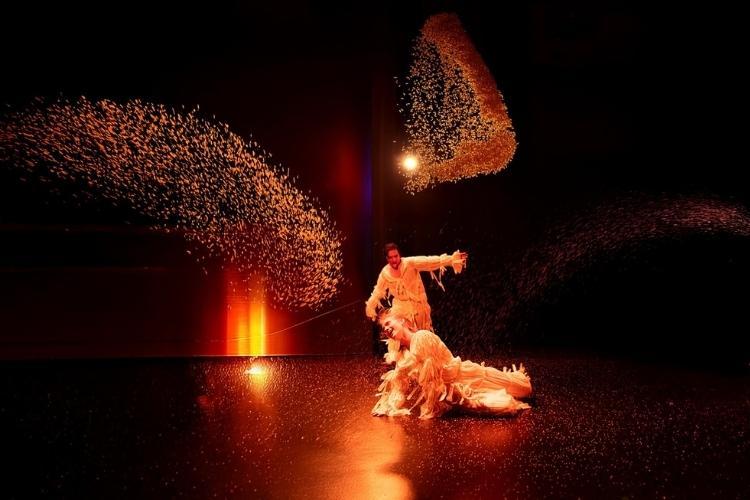
Image © Georgia Haupt
How would you explain the mix of movement, storytelling and imagery audiences will see here?
It’s quite playful! We move through different performance modes – movement, text, stylistic fusions – and even reimagine the traditional New Benner Theatre space itself. I’ve never viewed contemporary dance as something overly serious; for me, it’s a form that allows us to express our fullest selves. And if you know me, I’m pretty playful, loud and a little bit cheeky – that’s the Filipino in me. It’s part of my rhythm. The work blends movement, storytelling and imagery almost like a dining experience; a mix of flavours you get to taste in your own way. There’s a main course, maybe some dessert, perhaps even a bit of wine! It’s something to be experienced and digested differently by everyone. My interpretation will never be the same as my parents’, or my friends’, or anyone else’s – and that’s what I love about it. I want the audience to find their own entry point, their own meaning. And honestly, I’d love to chat with everyone after the show to hear what they saw, what they felt. That conversation is part of the work too.
What do you hope people will take away from the show, especially those who might not share the same cultural background or experiences?
The work is inherently Filipino because I am – a Filipino body shaped within Western frameworks. But beyond ethnicity, it’s really about belonging. About feeling both at home and out of place and finding where we fit amid all the versions of ourselves we’ve lived, lost or are still learning to love. 'Bahala/o' is an act of reconnection, to the parts of ourselves we’ve neglected, to memory and to possibility. Whether you’ve ever felt in-between, uncertain, or like you don’t fully belong anywhere, 'Bahala/o' speaks to that. It’s both a celebration and a contemplation, a space where surrender meets resilience. There’s something universally human about letting go of control while still moving forward with all the weight, and maybe a bit of chaos, that life brings. While it’s rooted in the Filipino diaspora and queer experience, the work invites everyone to reflect on their own journeys of identity and change. 'Bahala/o' holds space for the beautiful complexity of being, where cultures blend, identities shift and the self is never fixed. It’s a quiet hymn to resilience, a dance between trust and surrender, and a reminder that in the uncertainty, there’s a quiet freedom. That sometimes, to hold on is to let go, and in that paradox, we discover versions of ourselves. Beyond the conceptual meanings, this work also represents the ongoing persistence and effort of independent artists in a growing sector. It shows what can happen when organisations choose to back bold, original voices; when they believe in the power of local stories. 'Bahala/o' builds on the foundations laid by those before us, contributing to a more inclusive and representative creative landscape here in Queensland. Asian/Queer/independent artists exist in Magandjin, they’ve always existed, and I hope this work serves as a small reminder of that. Truly, if I can do it, anyone can.
Can you tell us a bit about the collaboration between the two performers on stage – how do you balance your own stories and perspectives within the piece?
Impulse has really been the guiding force. Clare and I are completely different and that difference is the beauty of it. We lean into our contrasts, our energies and our instincts. The work became a dialogue between us, where our differences don’t clash but coexist – much like the layered identities we explore. But beyond those differences, there’s also a deep sense of kinship. We both live the queer experience, especially in a rural context, and that shared understanding sits quietly beneath everything we do. It’s in the way we move, the way we listen, the way we hold space for each other. We acknowledge our flaws, our strengths and the things we admire in one another. Ultimately, we understand that we exist differently and that’s something to celebrate. Our contrasts give the work its texture, while our similarities give it heart. Together, they form the pulse of 'Bahala/o'. Throughout the process, I developed three ‘layers’ within the work that helped us navigate this idea of multiplicity and the multiverse of self. There’s the external story, which the audience experiences; the skin story, which carries the conceptual and embodied significance for us as performers; and the internal narrative, which we each discovered in our own ways. These layers guided the work and allowed it to hold multiple meanings – one for me, one for Clare and many for those watching.
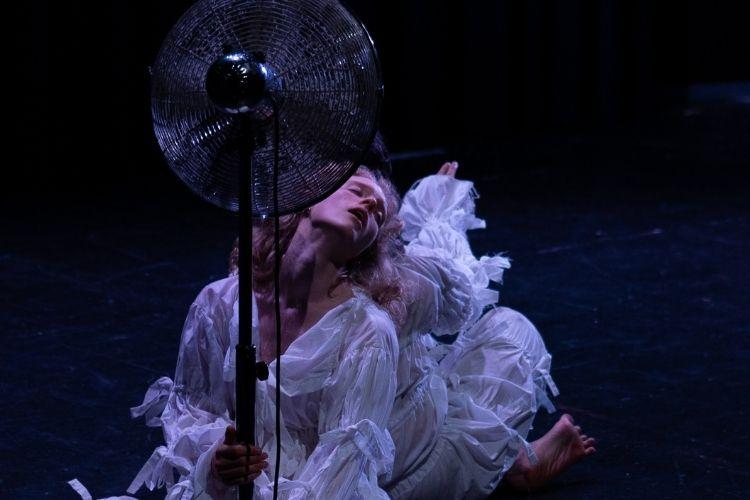
Image © Georgia Haupt
The BIPOC + Queer Community Night includes an artist talk – what kind of conversation are you hoping to spark there?
I want the artist talk to go beyond the show itself – to open space for shared stories, lived experiences, and the intersections of queerness, culture, and creative survival. It’s about community, about holding space for laughter, vulnerability, and honesty. “Chika chika” in Filipino simply means chit-chat, an unfiltered, playful conversation. I’ve always loved talking; honestly, it’s been a dream of mine to have a podcast (yes, typical) and fun fact: I was voted 'most likely to be a YouTuber' in high school. Maybe it’s finally time to ‘Bahala na’ and achieve that dream, but for now, this artist talk is our playground to just talk and talk with the community. Being BIPOC and Queer as independent artists isn’t new. It has always existed. I hope this conversation can reflect that reality: that our stories are here, that our creativity thrives and that if I can navigate this path, really anyone can. It’s a chance to connect, share and remind each other that our identities, our cultures and our voices matter. And that we can celebrate them together. And yes, you will probably see me living my Miss Universe fantasy when audience members ask questions. . . PHILIPPINESSS!
As an emerging Queensland artist, what’s it been like developing 'Bahala/o' with Metro Arts?
It’s been incredible. I’m only three years out of university and I honestly never expected to receive this level of trust and support from Metro Arts so early in my career. It’s something I’ve always dreamed of and to see it happening now feels surreal. As an independent artist, one of the biggest challenges has been wearing so many hats while creating and performing a full-length work. It’s not just about choreographing or being on stage; it’s producing, managing, marketing, meetings on meetings, applying for grants and doing all the invisible work that keeps a project alive. It can be overwhelming, but having an organisation that believes in you, that offers encouragement, guidance and genuine support, makes all the difference. There’s so much local incredible talent and emerging rigour here in Magandjin and I feel incredibly privileged to have this platform. 'Bahala/o' is a true testament to what happens when organisations truly invest in local voices and champion independent artists.
Finally, what’s next for you after 'Bahala/o' – are there any projects or ideas already bubbling away?
Oh, my brain truly never stops! There are already a few things bubbling away; plans for a return to the Philippines very soon, some time in Europe, a new solo work and a dream project with a Filipino creative team. Collaboration has always been the heartbeat of my practice, so my inbox and DMs are always open. I love finding new connections, new languages of movement and new ways of storytelling, especially with artists who carry the same fire and curiosity. As for 'Bahala/o', it feels almost poetic to say this, but bahala na. The work has always had a life of its own; unpredictable, ever-shifting, and delightfully chaotic. I have a feeling it will find new forms, new contexts and new communities to live in. Maybe it’ll return home to the Philippines, maybe it’ll travel somewhere completely unexpected – who knows? For now, I’m just excited to keep creating, keep experimenting and keep listening to wherever the art wants to go next. 'Bahala/o' has reminded me that sometimes the best thing we can do is to trust the current, surrender to the flow and let the next chapter reveal itself, one grain of rice at a time.
'Bahala/o' plays Metro Arts' New Benner Theatre (Brisbane) 19-29 November.
This story originally appeared on our sister site, scenestr.